Check out our Winter 2018 Newsletter, along with an End-of-Year overview of the successes of our programs. Click on the image to read the full newsletter.

FACES for the Future Coalition
Changing the face of health.
Check out our Winter 2018 Newsletter, along with an End-of-Year overview of the successes of our programs. Click on the image to read the full newsletter.
 Q: Tell us about yourself!
My name is Nikita Sanghavi, and I am a FACES Summer Medical Academy (FSMA) alumni! I participated in 2016, between my sophomore and junior years of high school. I graduated high school in June 2018 and am now a freshman at UC Davis.
Q: What inspired you to pursue a career in the healthcare field?
Being a healthcare professional means that you are there for people during some of the most vulnerable times in their life. I know it would be such an honor for me to help people during that time.
Many people see hospitals as depressing places, but I’ve always seen them as these incredible havens for healing. Through programs like FSMA and volunteering at a hospital, I’ve seen how patient-centered medicine can create a calm, healing environment. I want to be able to offer that kind of treatment to everyone in need.
Q: Congratulations on going to college! Where are you going and how are you feeling?
I’ll be starting at UC Davis this Fall pursuing a major in Neurobiology, Physiology, and Behavior. I’m definitely nervous, and I’ll miss my family, but I’m also so excited about all the new opportunities available, such as interesting classes, more volunteering experiences, and meeting new people. Starting off, I’m participating in a massive Pre-Health Conference. Again, I’m ecstatic for everything college has to offer.
Q: You recently wrote a research paper on pediatric palliative care in the United States. Can you tell us what made you interested in writing on this specific topic?
Another impactful moment I had at FSMA was touring George Mark Children’s House (GMCH). GMCH is a pediatric palliative care facility. This means they provide care to children with life-limiting illnesses, who will not survive until adulthood. This care not only helps manage the child’s medical needs, but also the child’s and their family’s emotional, mental, and physical needs.
When I first walked into GMCH, an overwhelming sense of peace washed over me. It’s an odd feeling to have in such a center, but I’ve come to realize that peace is exactly what this house offers to patients and their families. GMCH gives these children a chance to enjoy their life, and it is truly a vibrant, happy place.
After FSMA, I began volunteering at GMCH, and I experienced firsthand the incredible work done at this center. More than that, I was shocked to discover that in most of these cases, insurance doesn’t cover palliative care. Moreover, there isn’t any legislation in the US to help provide this care. Knowing the important work GMCH does, I knew I wanted to write about the lack of pediatric palliative care in the US. People don’t want to talk about children dying, but this lack of conversation only hurts the families in this position. I wanted to help bring more attention to this issue.
Q: In your opinion, what is the importance of learning how to write research papers?
I had some difficulty when I first starting writing research papers because I’ve always been more interested in stories and emotional background than listing out facts. But, then I learned that one major cause for the lack of pediatric palliative care was the lack of research surrounding it. Research papers allow you to effectively convince others the importance of your issue, whether your audience is your teacher in high school or government officials. By presenting your findings in a professional, fact-based manner, you gain credibility and influence. Also, if you are writing about something you’re especially passionate about, it comes across clearly in your writing. Instead of a list of facts, your paper becomes a cohesive, strong, interesting argument.
Q: We have other FACES students and alumni that need to write research papers in their classes. What are some tips or suggestions you would give them for writing a successful research paper?
Q: What are some tips or suggestions on how to do a successful presentation?
 It’s not something my family talked about much – at least not openly. But there have been members of my family who have committed suicide, who struggled with addiction or who tried desperately to manage a mental illness while shrouded in silence. As time marched on and I became an adult, it began to make less and less sense to me – the silence. I understood it, of course – it was part of my culture as it is with so many of us – but I struggle to be a part of it any more. There was so much stigma attached to these family members and their struggles that IF those issues were discussed, it was always in hushed voices. And as I grew older I began to understand how silence itself contributes to the mental health problems individuals face, as well as those we face in our communities. I have learned stigma is dangerous and leaves people to suffer when there is help available if we could just get over the hushed voices.
 To help fight the silence, this summer FACES Coalition Program Manager, Jasmine Nakagawa-Wong, and I took advantage of an opportunity offered by Alameda County Behavioral Health Care Services and we became certified as trainers in Youth Mental Health First Aid. That means we can train and certify adults connected to young people who want to be armed with some tools to help them if a serious mental health situation should arise.
It is no different than learning CPR – it’s potentially life-saving information and vital that we take on MHFA certification as we would any other community based public health effort. We are all connected to youth – through our families, our work, our faith communities, our neighborhoods – even in public spaces. It is incumbent upon us to do all we can to help them if a situation should arise. It can be a matter of life and death.
Do you know what you would say or do if a young person disclosed something sensitive to you? Do you know how to approach them if you have concerns about their behavior? Do you know what you would say to them if they admitted to you that they have thoughts of suicide or self-harm? Do you have a plan for how you would get them connected to professional help, when to call for that help immediately, how you would support them afterwards or how anxiety or depression may present in someone who is say, 14 years old? If you are a professional who works with youth, do you have answers for those questions for a youth you know in your personal life? If you’ve hesitated even once – I ask that you please consider getting certified in Youth Mental Health First Aid.
 If you or a group you belong to are interested in getting certified, please call the FACES for the Future Coalition offices. The certification lasts for 3 years and is useful to those who work with youth professionally (e.g. educators, coaches, youth leaders) or those who just want to be better prepared to support the young people in their lives. We can walk you through options for certification and answer any questions you may have about the training. I have attended many trainings and I still found value in this certification – even as a parent of teens.
Help is possible. Recovery happens. And hope is real. These are true things.
But none of that occurs for a young person if we stay locked in silence, if we don’t do all we can to intervene, if we continue to hide behind stigma instead of coming together as a community to support our youth. Please help us support youth by considering certification.
Written by Brooke Briggance, Deputy Director, FACES for the Future Coalition
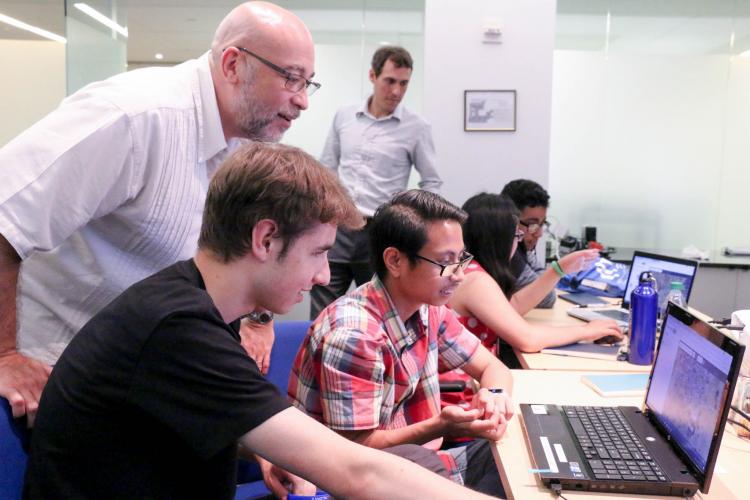
As a nation and society, we often unfairly view youth from underserved communities through a deficit lens. Frequent terms used to describe these young people include “at risk” and “marginalized,” referring generally to young people who face situational circumstances that we believe will inevitably lead to their personal and professional failures. Labeling youth as “at-risk” presumes that these children will have poor outcomes, despite never having been given a chance to prove otherwise. Moreover, these terms perpetuate destructive stereotypes of young people in our country, missing the mark completely in defining who these young people truly are and what they can contribute to our world.
Those of us who work with youth from difficult backgrounds prefer the term “at-promise youth.” “At Promise” references the extraordinary raw potential every young person possesses. The term views youth through a strength-based perspective. It also helps to fill in some of the details missing in the former labels, reminding us that youth have natural gifts and innate potential for greatness.
Circumstances do not define youth; it is how those young people transcend those circumstances that defines who they are and what they are capable of doing.
Over the past three years, our FACES for the Future Coalition has proudly partnered with the Global Health Fellows Program (GHFP) II and the US Agency for International Development (USAID) to prepare at-promise youth for careers in global health. Our work is based on the premise that these young people are ideally suited for global health careers because they have developed the necessary competencies for effective global health practice through their lived experiences. We know children who confront adversity in their communities, particularly on a regular basis, must develop and master skills that enable them to effectively navigate their way through those circumstances. For them it is not a matter of choice – it is matter of necessity.
As a pediatrician, I have unfortunately witnessed the disastrous impact of adverse community experiences on youth I have cared for over the years. Community violence alone has killed too many of my patients and traumatized more than I can remember. But, I have been deeply inspired by seeing how young people respond and rise above those moments of crisis and adversity.
Community challenges, such as poverty, violence, food deserts, and poor access to basic support services, often teach young people very harsh but effective lessons about resiliency, innovation, adaptability, resourcefulness, creativity and independence. Research has shown that these are key soft skills global health employers seek in early career professionals, and these are not the lessons learned in a classroom setting. How they effectively respond to those challenges helps form the important lessons that test and reinforce the “promise” of young people.
How does this connect to global health? We teach our students that these skill sets are not unique to young people in this country; they are also exemplary of the skills that individuals in communities across the globe acquire from confronting similar challenges. There are shared and common experiences between our youth and others in the world. We inform our students that a US global health worker who understands and has mastered those skills through lived experience is, in many ways, best equipped to serve the needs of his/her global counterpart.
Our work with GHFP-II has allowed us to teach our youth about the potential they have for impacting the health and wellbeing of global communities in very profound and substantial ways. Students are learning to reframe their challenging lived experiences as assets, and to understand how those assets constitute much of the promise they bring to the world and to the global health field. Ultimately, it will be the students themselves, and not just us, who can demonstrate why they are well suited for a future in global health.
Interested in hearing from the students themselves? You can read their blogs here.
-Tomás A. Magaña, MD, MA, FAAP
Founder & Director, FACES for the Future Coalition

FACES South Alameda County graduating seniors with Program Coordinator, Reatha Conn.
“Good evening ladies and gentlemen. I am truly honored to be here with you this evening.
Reatha (Program Coordinator) has been with your students every step of the way and has been very instrumental in facilitating this program in a positive manner. So I would like to say thank you to Reatha and the entire FACES team for your energy and efforts in developing these students and helping them step forward into a future in healthcare.
I always say working in health care is a calling… You have to have a passion for helping others. I tell my staff that when you arrive at work, to leave emotion at the door. Once you step through the doorway, everything you do should be about patient care.
As you step into the future of healthcare, it is important to know that you are going to see, hear and experience a variety of circumstances. Some will be more challenging than others. But if your heart is in it and if you maintain your focus, you will be successful no matter what that challenge might be.

Left: Eulix and Edward posing at Alameda Hospital. Right: Eulix in a safety “bunny suit”.
There are a lot of uncertainties in life, especially when it comes to our health. So we try to do everything in our power to live healthy lives and foster healthy environments.
As the Environmental Services Manager, my role is to ensure we work in a clean and safe environment for our patients, visitors, and staff.
When I was first asked to be a part of the FACES for the Future program, I was initially reluctant. My first thoughts were that the students don’t need to know how to clean. They are stepping into healthcare to become doctors, nurses, radiology techs, nutritionists, and clinicians.
So I asked myself, what can I offer these students that would, number 1, keep them engaged, number 2, would be meaningful, and number 3, have a lasting effect on them. Because I am the EVS Manager, I have a role to play in every department. So I decided to treat them as if they were new supervisors and needed to be trained on every aspect of environmental services.
Eulix and Megan were my students. Both were very much engaged and focused, although Eulix, with his sly sense of humor, kept me on my toes. Eulix said to me, “I never really paid attention to the smells that are in hospitals”. A patient was being changed at the time. My only response to him was “life is good”.
We rounded on all departments, we inspected rooms, I even had them interacting with patients performing Patient Satisfaction Surveys to ensure we were meeting their expectations. Occasionally, we joined with other groups to listen in on the lessons that were being taught by my fellow mentors.

Edward with a few FACES South Alameda County health scholars.
This allowed them to meet many employees and managers of various disciplines, from the operating rooms to the emergency room, with my objective being to expose them to other areas of the hospital that might interest them as well as letting them experience the enthusiasm and love people have for their respective fields. All the while, teaching them about maintaining a clean environment, that every position in the hospital is valuable, and we all have a unique role to play in the care of our patients.
In healthcare, the quality of care we give our patients is of the utmost importance. Alameda Hospital and as a member of the entire Alameda Health System. our mission is caring, healing, teaching, and serving all. So as you further your education and knowledge in healthcare, I would encourage you to remember the experience you had here. Remember the lessons you learned from your mentors and how passionate the various employees were when they spoke on why they chose the field they were in. The overall answer is because they love what they do. That very deep passion and love saves lives.
I have worked at several hospitals and no hospital I have had the privilege of working in, represents their mission more than Alameda Hospital. So you all have been able to step into a hospital that truly cares for the lives of others. Cherish the lessons you learned here, and know that whatever path you decide to take in health care is valuable, important, and can make a huge difference in someone’s life.
Thank you!”
-Edward Hinton, 6/1/2017

FACES for the Future students in San Diego are a special part of the Rady Children’s Hospital family. When I first met Dr. Tomás Magaña in 2008, I was inspired by the work he had been doing and the students I met in Oakland. My intention was to develop a similar program for a group of students at Hoover High School in City Heights, an urban neighborhood in San Diego. We worked with all our heart to design a program that would provide academic rigor, career exploration and campus visits to a variety of colleges and universities, professional development and real-world career experience. We worked with clinicians in our hospital to design relevant career experiences, funders to provide support and guidance, and school counselors to manipulate what was to me the mysterious master schedule so we could group the students in a cohort that would travel through the program together for the next 3 years. We recruited 25 sophomores, and planned to take up to 30 new sophomores each year for a total enrollment of 90 students. We identified a program coordinator and a team of teachers. Then we turned on the switch and our enthusiasm was contagious. Every aspect of the program we had planned was important, but the magic of the program shines through a heart-centered approach that values compassion, family, friendship, community and purpose.
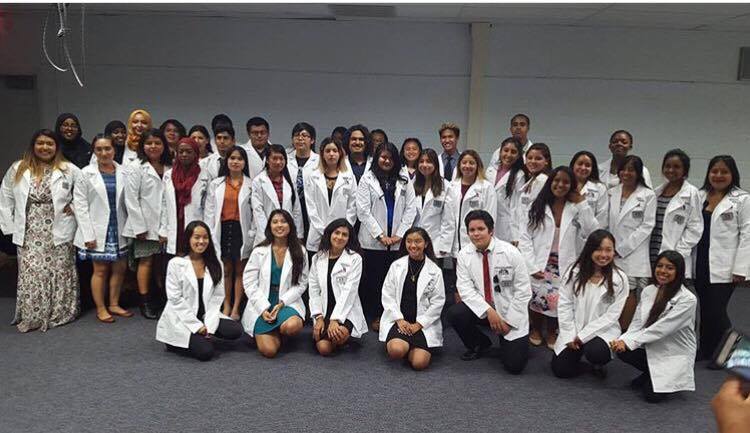
Lab Coat Ceremony for Class of 2017.
Our students are learning, growing, graduating high school, setting career goals, pursuing post-secondary education and our first class is just starting to embark on their careers. FACES has become very popular with students. Today the program has grown to nearly 300 students at Hoover High, expanded to another 80 students at nearby Crawford High, and has become a highly reputed program in San Diego. Each year we ask the students what has been the most important part of the program over their years, and each year we hear the same response: the sense of family and the opportunity for real world experiences with people who care. The refrains I’ve heard from the students are, “if it weren’t for the FACES family I would have dropped out of school, I couldn’t have done this, I wouldn’t be going to college, I don’t know where I would be, I wouldn’t have been able to handle my life, I would have no purpose.” And each year I reflect on – how does this happen? I ask myself, “How does a group of diverse students, representing a wide range of cultures, ethnicities, languages, histories, beliefs, struggles and community experiences become a family and why is this so critical to their success?”
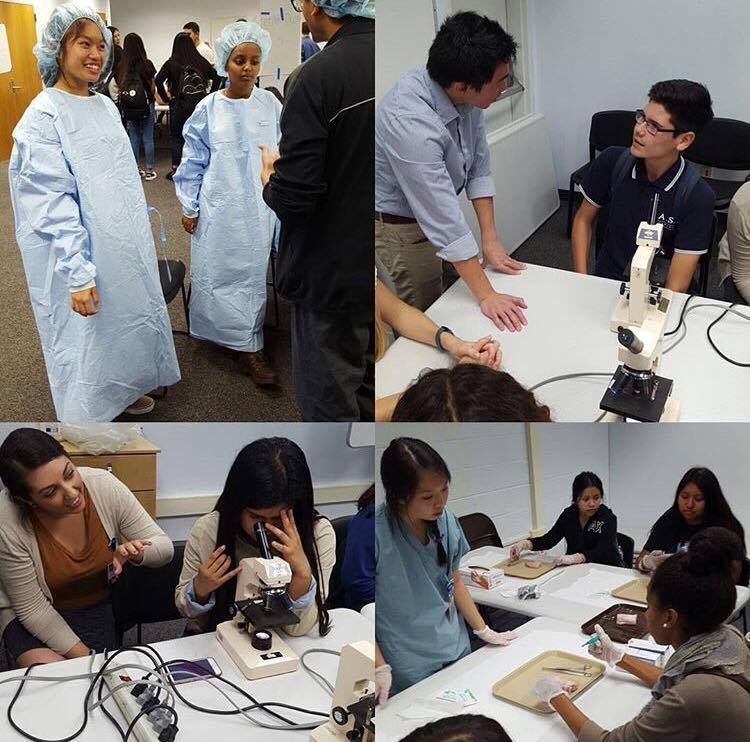
Sophomore and Junior students at Doc 4 a Day with UCSD residents.
What I have seen is that the sense of belonging, connectedness and community is truly a protective factor for youth that builds their resiliency and self-confidence. What I have come to understand is this starts with the passion, determination, and a heart-centered approach of a few influential champions whose desire is to inspire and provide equal opportunities for disadvantaged youth to reach their full potential. This is a powerful catalyst and at the core of starting a new program. Everything radiates from this. Selection of program staff and teaching staff is key, and an essential ingredient beyond technical skills and knowledge is the embodiment of the same determination and heart-centered approach. The staff are role models, leaders, coaches, educators, confidants, cheerleaders, trouble shooters, planners, integrators and a resource for the students. In our programs, the school provides space for the FACES program, and the staff are housed at the school every day and available to the students. They guide a culture of compassion and purpose, providing workshops, coordinating college field trips and team building activities, monitoring student performance, providing psycho-social support, arranging for and coordinating career experiences for the students, and connecting with teachers, school counselors, other school personnel and parents. They give their heart, and the program leaders provide training and resources to encourage their self-care, reflection, a learning environment, camaraderie and building their own sense of family, direction and purpose.
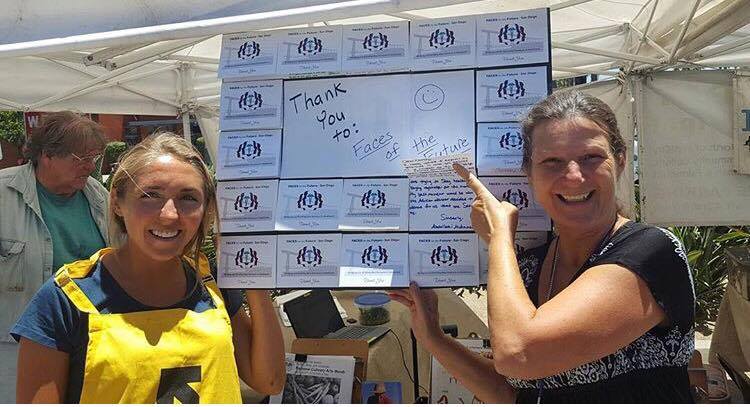
Farmer’s Market community with Thank You cards from FACES students.
Building this positive sense of community for the students starts with engaging them in the community. Our community partners are an essential and integral part of FACES, helping the students build community while learning about the importance of social and economic determinants that influence optimal health outcomes and one’s ability to reach their full potential in a life of purpose. The students get started participating in community service activities in their first years in the program, and in their junior year they are placed in community health-related organizations for job shadowing and career experience rotations. Community organizations are selected that have a strong mission and purpose in the community, can provide a supervised experience for student learning, and mimic the same determination and values of the FACES program. It is an opportunity for the students to learn about health topics and resources available to them and their families and neighbors, while shadowing professionals in community-based health related careers. To reinforce their learning and experience, the juniors then conduct a school-based health fair for the student body; educating their peers and sharing how to access resources. As they educate their peers they become the experts and gain confidence in their own abilities and knowledge. For many students this is their first experience requiring them to be accountable in a professional setting and it also builds their sense of connection and pride with the larger community in which they live. By the time the students begin their clinical rotations in Rady Children’s, they have been well-prepared and well-supported and are welcomed into the Rady Children’s family of caregivers. This is frequently when students become inspired to pursue specific career pathways. Hospital staff mimic the same values and demonstrate heart-centered care and support. For the students, these experiences, coupled with team building, college tours, and workshops all work together to create a structure where the students are learning together, sharing new experiences, teaching each other, and building a sense of connectedness. This is the “sense of family” the students talk about.
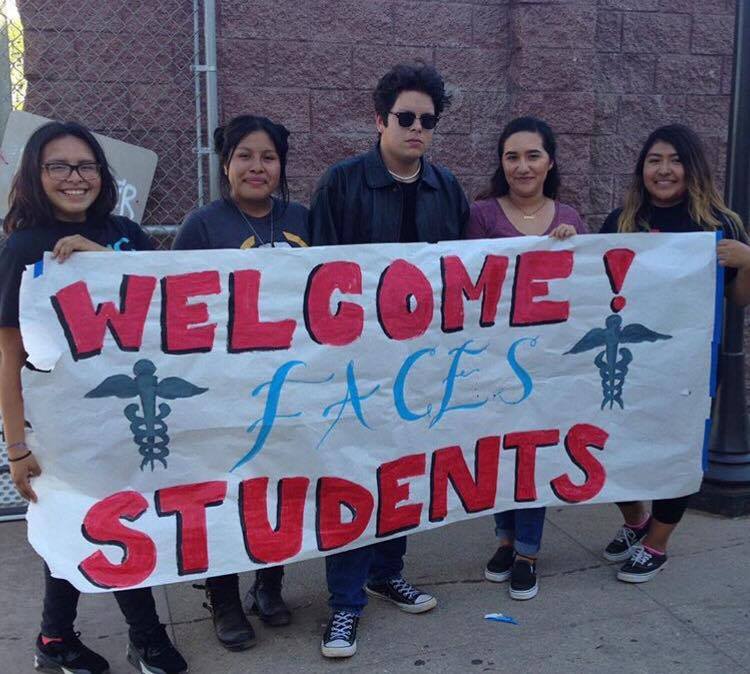
Students welcoming new students to the FACES family!
I believe what sets FACES apart as not just another career internship program is the underlying philosophy and daily demonstration of a heart-centered approach and belief that compassion, sense of family, community, and purpose is of utmost importance. Of course we focus on academic rigor and career exploration, and FACES is a health career pathway program, but it truly a unique youth development program. A young person’s character and purpose is not developed passively. Through experiences and trials and overcoming obstacles, coupled with the support of a compassionate family and community, students grow their inner strength, create clear visions, inspire their ambition, and set a path to create their own opportunities and achieve their own success. In turn, they become equipped to become compassionate professionals, family members and leaders who will bring positive energy and change in a complex world. There is an old Cherokee saying, “Every action should be taken with thoughts of its effects on children seven generations from now.” FACES is working to lay the groundwork and train the next generation of adults that will transform the quality of life for families and generations to come.

Cheri Fidler
Director, Center for Healthier Communities
Rady Children’s Hospital, San Diego, CA
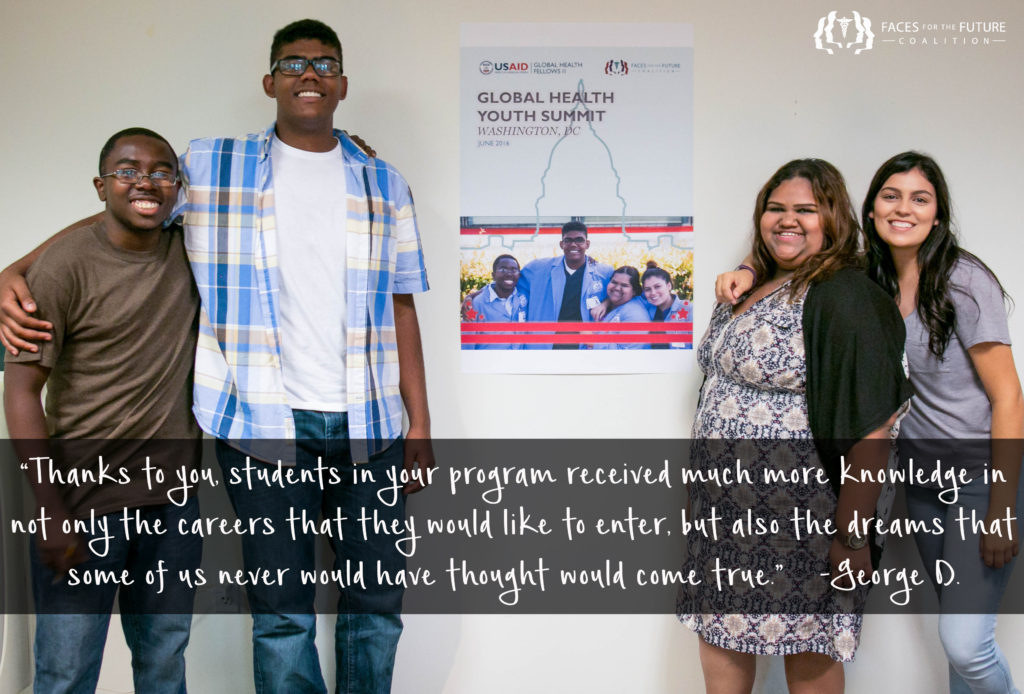 In June 2016, twelve FACES for the Future students, each representing a FACES program from across California (San Diego, Hayward, San Francisco and Oakland), traveled to Washington DC to participate in our inaugural Global Health Youth Summit (GHYS).
Read the various blogs from FACES Scholars who participated in the Summit and learn how that experience impacted them. Go to BLOGS.
 Often, I’ll hear someone ask in a diversity conversation, “Why do we need to start so early in order for students to succeed? Why high school?” My response is simple – because we are losing too many valuable diverse candidates with lived experience before and during college. How do we expect to benefit from all they have learned through navigating systems, challenges and adversity and put that knowledge into practice in a global context if they are never able to get there?
FACES for the Future programs are meant to help minority high school students achieve greater access to careers in health care. Founded in 2000, the program has supported students interested in careers in medicine, nursing, allied health, public health and behavioral health. We have programs throughout California, and recently we were awarded a grant from the Office of Minority Health to begin scaling nationally.
But program replication isn’t our only mission. We want to constantly innovate our program model to address new concerns in health workforce development. Over time our team understood that the issues of diversity we face domestically are not unique, so we set our intentions toward addressing the need for diversity within global health. We did this to support FACES students of course, because we knew our students need support to achieve their professional goals. But more importantly we did it for others, because we know our nation needs skilled, diverse health workers to lead the next generation in finding solutions to health and wellness issues globally.
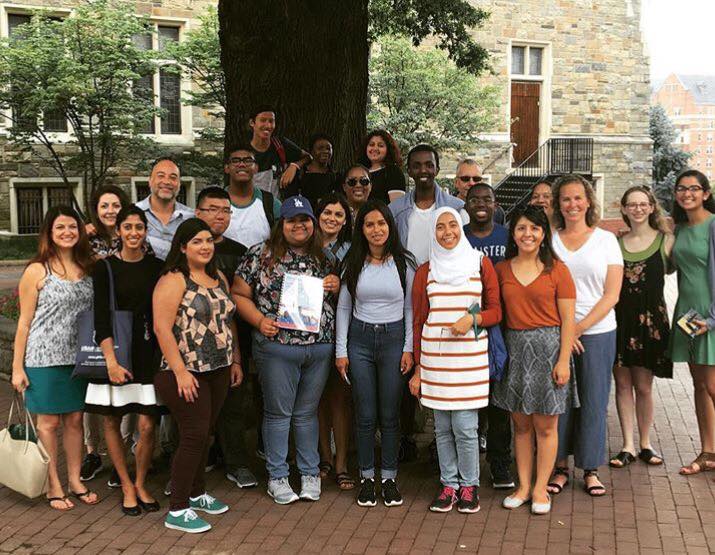
Over the past two years, FACES has had the pleasure of partnering with Global Health Fellows Program (GHFP) II, the US Agency for International Development (USAID) and GlobeMed to begin building a global health career pathway for underserved minority students. We’ve developed curriculum, trainings and webinars to expose high school students to global health. This effort culminated on June 21st when 12 students from across the FACES programs flew into Washington, D. C. to participate in the 2016 Global Health Youth Summit; a program co-developed by FACES and GHFP-II. I don’t know who is more excited – the students or me!
In a recent report from The Pell Institute for the Study of Opportunity in Higher Education entitled “Indicators of Higher Education Equity in the United States,” we learn that only 21% of low-income students in the United States who achieved acceptance into college end up being able to secure a Bachelor’s degree. Equally bleak, a 2014 National Student Clearinghouse report outlines that only 39% of entering students will either receive an Associate’s degree or transfer to a four-year college within six years, and a full 25% of students who enter a community college in the fall will not return in the spring.
Often times we talk about youth being the “first in their family to go to college.” But going to college and finishing college are two different things, and lead to drastically different economic results for that young person’s family, as well as in how that difference curtails our efforts to fully diversify the global health workforce.
All indications lead to the necessity of building global health professional pathway programs at the high school level in order to provide the services and supports that young people need to continue up the pipeline. Students need to be exposed to career options in global health sooner, need to gain experience in work-based learning and professionalism to be competitive for internships in college, and need to be supported with safety net services that allow them to transform challenges into opportunities.
Yet we know that disparities exist in K-12 education and while the well documented “achievement gap” is narrowing and high school graduation rates are up throughout the U.S., there persists an overall 26 point differential in all subject areas between black and Latino students versus their white peers. Students from environmentally disadvantaged and socio-economically disadvantaged regions need a “leg up” at the high school level in order to be competitive further up the global health careers pipeline. FACES is that “leg up.”
So the question becomes, “Why not just work with the students who get through on their own? What do we lose when minority students from underserved backgrounds don’t make it through the global health pathway?”
Well, I’d say we lose a lot. Take a look at a snapshot of one of our programs:
Hayward, California – 45 students (2013-14 and 2014-15)
While these students are certainly facing challenges that many of us would find untenable, they offer us the diversity, resilience and distance traveled we are looking for in the global health workforce of tomorrow.
But before we view them through a deficit lens, let’s also look at the reality of their resilience and inherent value to the global health workforce. This same group of FACES students represent 14 different ethnicities, speak seven languages and 68% of them are bi-lingual or multi-lingual. While 77% of them were not on track to graduate from high school when they were accepted into our program, with proper interventions, support and coordinated services they showed the tenacity to succeed. In the cohorts we examined, 100% of them graduated from high school and of those who applied to college 100% were accepted.
The key to diversifying the global health workforce is not found in pockets of students who are racially and ethnically diverse, yet who come from resourced backgrounds. If we view diversity through that lens alone, we are missing out on a great opportunity. We will not be able to leverage the lived experiences of youth who have overcome adversity and who will bring empathy, strength and tenacity to their interpersonal communication, team building and the limited resource management required of careers in global health.
To me, the irony of the FACES program is that we build programs to support students, but our world needs FACES students more than they need us. Who better to send to the refugee camps in Europe than students who have been displaced by violence and come with the empathy they need to help? Who better to send to a community where language barriers exist between those seeking health care and those providing it than a young person who has been the medical interpreter for their family since they were seven years old? Who better to work with communities facing environmental toxins better than someone who has lived in a disadvantaged community and whose sibling’s asthma was worse because of the air quality in their neighborhood? We need their lived experiences, we need their tenacity, and we need their ability to problem solve.
That is why I am so proud to be a chaperone for the 2016 Global Health Youth Summit. Yes, it will be wonderful to be with young people as they see the Lincoln Memorial for the first time, or see the White House or for a few, get on a plane for the first time! But I’m most excited to have them meet the incredible mentors from USAID, GHFP-II and GlobeMed, who are going to open up a world of possibility for them. Through the Global Health Youth Summit, they will have the opportunity to envision themselves in a career serving people around the world. And the adults will be able to envision a world where the very best of the United States is represented when we reach out to communities across miles to find solutions to health issues.
 For the past two years, FACES for the Future Coalition has proudly partnered with the Global Health Fellows Program (GHFP) II to develop a global health career pathway for diverse youth underrepresented in global health. To this end, our goals are to expose youth to global health careers at an early stage of their educational development and to inspire them to pursue careers in global health. GHFP-II and FACES believe that our youth reflect the diversity of backgrounds and lived experiences that will make them ideally suited for global health careers.
The process of educating young people about global health has been an extraordinary experience. Our students have embraced the notion of global service and many, who are immigrants themselves or come from immigrant families, have expressed a personal connection with the values that are inherent in global health work. Often through sheer necessity, they have already developed unique skills, such as resilience, innovation and cross-cultural communication that align well with the skills required for global heath work. For me, it has been a privilege to witness their awareness evolve through global health competency and leadership training.
For youth we work with, simply talking to them about career opportunities in global heath is insufficient and frankly, ineffective. The perceived and structural barriers our students face conspire to prevent them from viewing those careers as realistic options, even when they possess an interest. As one FACES student shared, “Being from where I grew up, it’s a challenge because the first thing on your mind isn’t becoming a doctor or anything. It’s really just about survival and how you’re going to be a provider for your family.” Career awareness is only part of the process – it is a start. We must work with the students to address their realities and priorities, and attempt to reframe the notion of possibility for them.
As we approach the eve of our first Global Health Youth Summit (GHYS) in Washington DC sponsored by GHFP-II, there is a palpable energy and excitement among the students. In a few days, twelve capable, enthusiastic and diverse youth scholars, representing all FACES’ programs in California, will travel to DC to continue the work we started with them locally. We’re leveraging the global is local framework for this Summit, given the diversity of our youth and their deep desires to give back to their largely immigrant home communities.
Following years of GHFP-II and FACES GH curriculum and leadership development, they possess a basic knowledge of global health practice, career opportunities and the skills required to be a competent professional in this sector. Equally important, they have done personal reflection on why global heath careers make sense for them. The Youth Summit in DC is the culmination and next natural step of professional development for these students. And it is a necessary step. Building off of USAID Global Health bureau’s leadership, GHFP-II and FACES see this Summit as a call to action. We must build upon the awareness, reflections and foundational knowledge by providing mentorship with global health professionals. We must continue to not only create more opportunities for minority students to enter the global health workforce, but challenge the Agency and other government agencies like it, to increase opportunities and activities for more students to gain the experiences needed to work in this field. International experience is a USAID/GH requirement for employment, and yet only a small percentage of the possible GH workforce has this opportunity.
On the other side of this equation, GHFP-II and FACES seek to challenge the students to make connections between health in their local communities and health around the world. This is the fundamental notion behind global is local. For most, it will be the first time they have traveled outside of their local communities. So, during the Summit we plan to strengthen the links between the skills students developed in our preparatory curriculum and a potential future global health career with the USAID. We will ask them to put some of the basic theories of global health into practice through simulation activities with the mentors. We will ask the students to reflect on their experiences and growing awareness of global heath through blogs and social media. We believe the Summit will be a deeply transformative educational and personal experience for these students. Their profound excitement about this opportunity is already palpable and contagious!
As our complementary partner, GHFP-II and the Public Health Institute, FACES’ host organization as well, has provided critical resources to create a learning pathway for diverse, underrepresented and disadvantaged youth. GHFP-II has not only helped to inform our content and training processes, but they have designed a truly unique and innovative global health career experience for deserving high school students. This early career intervention will empower these students to continue to strive beyond their circumstances and see this career pathway as an avenue to better themselves and their community, while meaningfully contributing to the global health workforce. The students and I so look forward to being in DC later this week with GHFP- II to continue doing the work to develop future global health leaders!
See more at: https://www.ghfp.net/content/immersing-youth-global-health#sthash.zNLmjBuz.dpuf
 Our commitment to empowering young people with the skills, training and experience to succeed personally and professionally has been unwavering since 2000 when the first FACES program was launched. To that end, FACES programs have served more than 800 youth throughout California over the past 16 years. This journey has been extraordinary for all of us who have been involved in FACES programs. It has been a journey of significant discovery and growth – elements that are inherent in any effort that works with young people.
This important journey started with an understanding of some very clear challenges.
In 2000, healthcare was facing tremendous gaps in its workforce. Moreover, the existing healthcare workforce did not adequately reflect the tremendous cultural and linguistic diversity of communities that our healthcare institutions were serving. Mirroring the general population throughout the nation, California’s health care consumers were extraordinarily diverse. At the same time, significant disparities existed in the workforce responsible for delivering health care to them. Although they represented more than a third of California’s population, Latinos and African Americans comprised less than 5% of the state’s doctors. Similar data existed for other healthcare professions. Clearly, our state workforce did not represent the rich cultural, ethnic and linguistic diversity of its communities.
We also understood that the reasons for the lack of diversity among California health professionals were complex. A plethora of socioeconomic factors in predominantly disadvantaged African American, Latino, and Native American communities conspired to close doors for students with professional aspirations to pursue careers in the health professions. Public school students in Oakland and Berkeley, for example, struggled daily with the effects of low-performing and poorly resourced schools, limited role models, lack of extracurricular resources, and the stresses of living in neighborhoods with high rates of poverty, crime, violence, and unemployment. For the youth residing in our local disadvantaged communities, homicide was quickly becoming the leading cause of death. Another factor was the well-known “achievement gap.” A 2005 Harvard University study found that just 48 out of 100 freshmen who entered Oakland public high schools graduated. With such poor preparation, it was not surprising that young people from our communities entered college and graduated at much lower rates than other students.
We understood that if health care systems were to become more responsive to the complex needs of its consumers, health providers must appropriately respond to consumers from a broad spectrum of ethnic, racial, linguistic, and cultural backgrounds. A key strategy for increasing cultural competency in health care was to diversify the workforce to better reflect consumers. For this to happen, far more young people who reflected our community’s diversity must graduate high school in good standing and succeed in courses of study culminating in careers that support the health of community members. Results from the first 16 years of FACES for the Future programs have demonstrated that the time to start preparatory efforts is early in high school, if not sooner.
FACES alumni are now represented in multiple sectors of the heath care, non-profit and educational workforce. They are becoming and/or now serve as leaders and agents of change in their communities. They reflect the diversity of culture, language and “lived experience” that is so important in working effectively with people from different backgrounds. Regardless of the particular field they have chosen to pursue, they are invaluable resources, advocates and champions for the community. Alumni share that the early support, mentorship and training that they received in high school were instrumental in helping them to pursue their goals. We are deeply proud of the impact that FACES programs have had on the young people we have served, and we are even more proud of the impact that our alumni are having on others.
However, the work is far from complete. Unfortunately, the challenges that inspired us to create FACES sixteen years ago continue. Our national healthcare workforce still continues to experience profound shortages. While the ACA has increased accessibility to medical services, the efforts to increase the health care workforce are now being outpaced by demand, and we, as a nation, continue to face significant shortages in our workforce, particularly in primary care, allied health, nursing and mental health. Additionally, disparities continue in our educational pipelines. The documented “achievement gap” for disadvantaged youth persists, and although it is narrowing in some areas, all high school students in the U.S. are falling behind. The fact remains that young people from environmentally and socio-economically disadvantaged communities are particularly at risk for academic failure. The need to provide a holistic and comprehensive approach to address these workforce and educational challenges remains more relevant and important than ever, but not simply just at a local level. The urgency for national impact is clear.
We entered 2016 with a new federal grant from the Office of Minority Health to support our program replication efforts nationally. Following several successful years of statewide growth, we have now arrived at a time when we can address these pertinent issues on a national scale. It is a profoundly exciting time for us. It is an opportunity to affect positive change for our young people on a much broader scale. As a pediatrician and father, I cannot express adequately enough how important this is to me.
From its conception, FACES programs were designed to listen to young people and meet them where they are. It is at the core of what we do and what we will continue to do. I welcome each of you to walk with us, through your support and encouragement, in our efforts to change the face of healthcare through the empowerment of young people in our communities.
– Dr. Tomás A. Magaña, Founding Director of FACES for the Future Coalition