FACES for the Future Coalition

Changing the face of health.

  • Home
  • About Us
    • Introduction
    • Our Leadership
      • Our Vistas
      • Affiliate Leadership
    • Our Youth
    • Our Impact
    • The FACES Youth Advisory Council 
    • Our National Expansion
  • Academic Year Programs
    • California
      • Alameda
      • Hayward
      • Sacramento
      • San Diego
      • San Francisco
    • Colorado
      • Denver
    • New Mexico
      • Albuquerque
  • Other Programs
    • Public Health Youth Corps
    • Summer Programs
      • FACES Summer Medical Academy
      • Behavioral Health Undergraduate Summit
    • Global Health Pathway
  • Resources
    • Blog
    • Media and News
    • Resources for Students
      • Program & Scholarship Opportunities
      • Health Careers Information
  • Alumni
    • Success Stories
    • FACES Connect Video Series
  • Contact Us
  • Hire Us

Why “At-Promise” Youth are Good for Global Health

As a nation and society, we often unfairly view youth from underserved communities through a deficit lens. Frequent terms used to describe these young people include “at risk” and “marginalized,” referring generally to young people who face situational circumstances that we believe will inevitably lead to their personal and professional failures. Labeling youth as “at-risk” presumes that these children will have poor outcomes, despite never having been given a chance to prove otherwise. Moreover, these terms perpetuate destructive stereotypes of young people in our country, missing the mark completely in defining who these young people truly are and what they can contribute to our world.

Those of us who work with youth from difficult backgrounds prefer the term “at-promise youth.” “At Promise” references the extraordinary raw potential every young person possesses. The term views youth through a strength-based perspective. It also helps to fill in some of the details missing in the former labels, reminding us that youth have natural gifts and innate potential for greatness.

Circumstances do not define youth; it is how those young people transcend those circumstances that defines who they are and what they are capable of doing.

Over the past three years, our FACES for the Future Coalition has proudly partnered with the Global Health Fellows Program (GHFP) II and the US Agency for International Development (USAID) to prepare at-promise youth for careers in global health. Our work is based on the premise that these young people are ideally suited for global health careers because they have developed the necessary competencies for effective global health practice through their lived experiences. We know children who confront adversity in their communities, particularly on a regular basis, must develop and master skills that enable them to effectively navigate their way through those circumstances. For them it is not a matter of choice – it is matter of necessity.

As a pediatrician, I have unfortunately witnessed the disastrous impact of adverse community experiences on youth I have cared for over the years. Community violence alone has killed too many of my patients and traumatized more than I can remember. But, I have been deeply inspired by seeing how young people respond and rise above those moments of crisis and adversity.

Community challenges, such as poverty, violence, food deserts, and poor access to basic support services, often teach young people very harsh but effective lessons about resiliency, innovation, adaptability, resourcefulness, creativity and independence.  Research has shown that these are key soft skills global health employers seek in early career professionals, and these are not the lessons learned in a classroom setting. How they effectively respond to those challenges helps form the important lessons that test and reinforce the “promise” of young people.

How does this connect to global health? We teach our students that these skill sets are not unique to young people in this country; they are also exemplary of the skills that individuals in communities across the globe acquire from confronting similar challenges. There are shared and common experiences between our youth and others in the world. We inform our students that a US global health worker who understands and has mastered those skills through lived experience is, in many ways, best equipped to serve the needs of his/her global counterpart.

Our work with GHFP-II has allowed us to teach our youth about the potential they have for impacting the health and wellbeing of global communities in very profound and substantial ways. Students are learning to reframe their challenging lived experiences as assets, and to understand how those assets constitute much of the promise they bring to the world and to the global health field. Ultimately, it will be the students themselves, and not just us, who can demonstrate why they are well suited for a future in global health.

Interested in hearing from the students themselves? You can read their blogs here.


-Tomás A. Magaña, MD, MA, FAAP
Founder & Director, FACES for the Future Coalition
Filed Under: Coalition, Global Health, Hot Topics

Global Health Youth Summit 2017

Filed Under: Coalition, Global Health, Hot Topics

Student Blogs – Mentoring the Next Generation of Global Health Workers

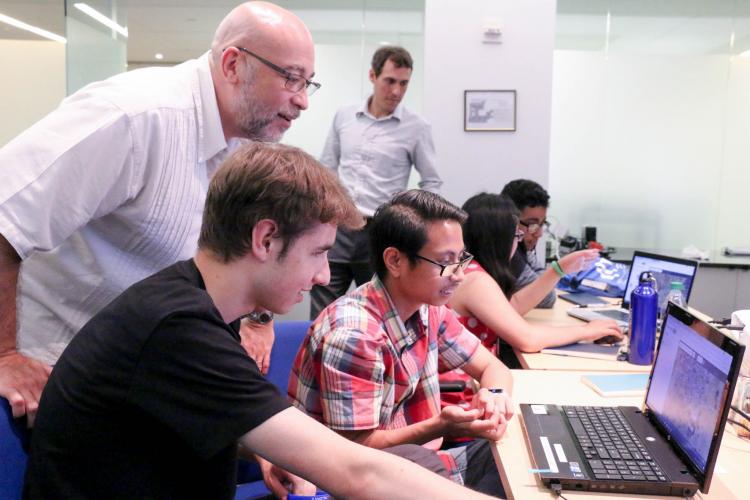
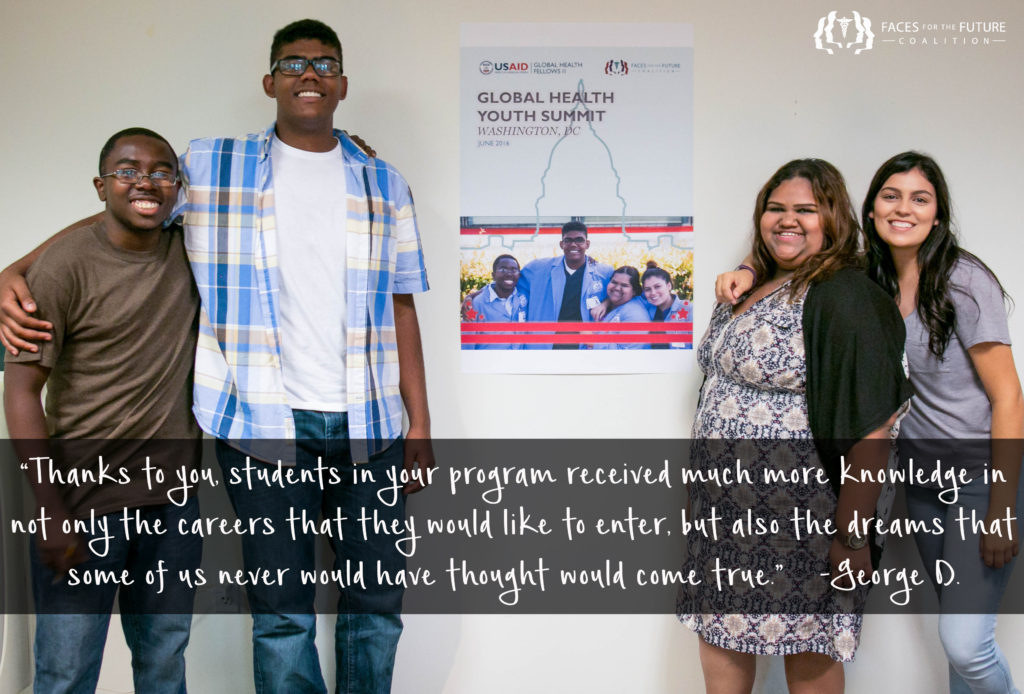
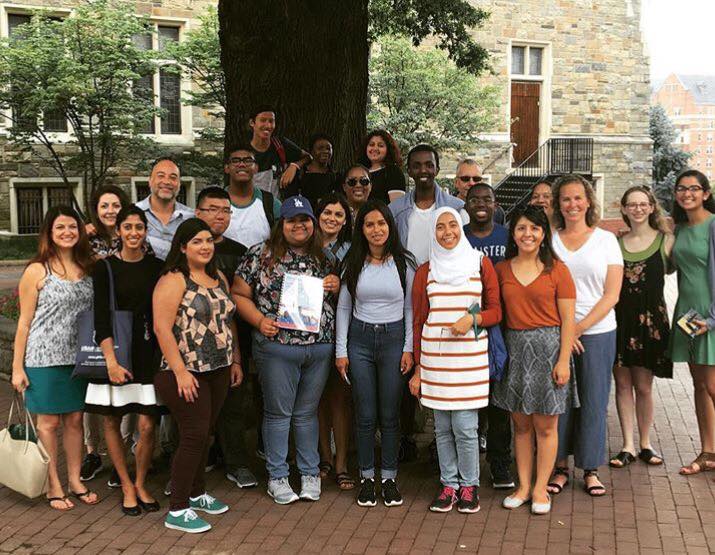
calendar 6In June 2016, twelve FACES for the Future students, each representing a FACES program from across California (San Diego, Hayward, San Francisco and Oakland), traveled to Washington DC to participate in our inaugural Global Health Youth Summit (GHYS).
Read the various blogs from FACES Scholars who participated in the Summit and learn how that experience impacted them.  Go to BLOGS.

Filed Under: Global Health, Hot Topics

Lived Experience and Diversity Are Essential to the Future of Global Health

13439155_10153888799894531_2724412775986411967_nOften, I’ll hear someone ask in a diversity conversation, “Why do we need to start so early in order for students to succeed? Why high school?” My response is simple – because we are losing too many valuable diverse candidates with lived experience before and during college. How do we expect to benefit from all they have learned through navigating systems, challenges and adversity and put that knowledge into practice in a global context if they are never able to get there?

FACES for the Future programs are meant to help minority high school students achieve greater access to careers in health care. Founded in 2000, the program has supported students interested in careers in medicine, nursing, allied health, public health and behavioral health. We have programs throughout California, and recently we were awarded a grant from the Office of Minority Health to begin scaling nationally.

But program replication isn’t our only mission. We want to constantly innovate our program model to address new concerns in health workforce development. Over time our team understood that the issues of diversity we face domestically are not unique, so we set our intentions toward addressing the need for diversity within global health. We did this to support FACES students of course, because we knew our students need support to achieve their professional goals. But more importantly we did it for others, because we know our nation needs skilled, diverse health workers to lead the next generation in finding solutions to health and wellness issues globally.

Over the past two years, FACES has had the pleasure of partnering with Global Health Fellows Program (GHFP) II, the US Agency for International Development (USAID) and GlobeMed to begin building a global health career pathway for underserved minority students. We’ve developed curriculum, trainings and webinars to expose high school students to global health. This effort culminated on June 21st when 12 students from across the FACES programs flew into Washington, D. C. to participate in the 2016 Global Health Youth Summit; a program co-developed by FACES and GHFP-II. I don’t know who is more excited – the students or me!

In a recent report from The Pell Institute for the Study of Opportunity in Higher Education entitled “Indicators of Higher Education Equity in the United States,” we learn that only 21% of low-income students in the United States who achieved acceptance into college end up being able to secure a Bachelor’s degree. Equally bleak, a 2014 National Student Clearinghouse report outlines that only 39% of entering students will either receive an Associate’s degree or transfer to a four-year college within six years, and a full 25% of students who enter a community college in the fall will not return in the spring.

Often times we talk about youth being the “first in their family to go to college.” But going to college and finishing college are two different things, and lead to drastically different economic results for that young person’s family, as well as in how that difference curtails our efforts to fully diversify the global health workforce.

All indications lead to the necessity of building global health professional pathway programs at the high school level in order to provide the services and supports that young people need to continue up the pipeline. Students need to be exposed to career options in global health sooner, need to gain experience in work-based learning and professionalism to be competitive for internships in college, and need to be supported with safety net services that allow them to transform challenges into opportunities.

Yet we know that disparities exist in K-12 education and while the well documented “achievement gap” is narrowing and high school graduation rates are up throughout the U.S., there persists an overall 26 point differential in all subject areas between black and Latino students versus their white peers. Students from environmentally disadvantaged and socio-economically disadvantaged regions need a “leg up” at the high school level in order to be competitive further up the global health careers pipeline. FACES is that “leg up.”

So the question becomes, “Why not just work with the students who get through on their own? What do we lose when minority students from underserved backgrounds don’t make it through the global health pathway?”

Well, I’d say we lose a lot. Take a look at a snapshot of one of our programs:

Hayward, California – 45 students (2013-14 and 2014-15)

  • 62% live at or below the Federal poverty line
  • 25% have a history of homelessness
  • 76% have incarcerated friends and family
  • 80% have fractured families due to divorce, abandonment and immigration issues
  • 39% will be the first in their family to graduate from high school
  • 95% have experienced violence both in the home and community

While these students are certainly facing challenges that many of us would find untenable, they offer us the diversity, resilience and distance traveled we are looking for in the global health workforce of tomorrow.

But before we view them through a deficit lens, let’s also look at the reality of their resilience and inherent value to the global health workforce. This same group of FACES students represent 14 different ethnicities, speak seven languages and 68% of them are bi-lingual or multi-lingual. While 77% of them were not on track to graduate from high school when they were accepted into our program, with proper interventions, support and coordinated services they showed the tenacity to succeed. In the cohorts we examined, 100% of them graduated from high school and of those who applied to college 100% were accepted.

The key to diversifying the global health workforce is not found in pockets of students who are racially and ethnically diverse, yet who come from resourced backgrounds. If we view diversity through that lens alone, we are missing out on a great opportunity. We will not be able to leverage the lived experiences of youth who have overcome adversity and who will bring empathy, strength and tenacity to their interpersonal communication, team building and the limited resource management required of careers in global health.

To me, the irony of the FACES program is that we build programs to support students, but our world needs FACES students more than they need us. Who better to send to the refugee camps in Europe than students who have been displaced by violence and come with the empathy they need to help? Who better to send to a community where language barriers exist between those seeking health care and those providing it than a young person who has been the medical interpreter for their family since they were seven years old? Who better to work with communities facing environmental toxins better than someone who has lived in a disadvantaged community and whose sibling’s asthma was worse because of the air quality in their neighborhood? We need their lived experiences, we need their tenacity, and we need their ability to problem solve.

That is why I am so proud to be a chaperone for the 2016 Global Health Youth Summit. Yes, it will be wonderful to be with young people as they see the Lincoln Memorial for the first time, or see the White House or for a few, get on a plane for the first time! But I’m most excited to have them meet the incredible mentors from USAID, GHFP-II and GlobeMed, who are going to open up a world of possibility for them. Through the Global Health Youth Summit, they will have the opportunity to envision themselves in a career serving people around the world. And the adults will be able to envision a world where the very best of the United States is represented when we reach out to communities across miles to find solutions to health issues.

See more at: https://www.ghfp.net/content/lived-experience-and-diversity-are-essential-future-global-health#sthash.HqNjKnGX.4NeMCqHf.dpuf

– By S. Brooke Briggance, Deputy Director of FACES for the Future Coalition

Filed Under: Global Health, Hot Topics

Immersing Youth in Global Health

13507103_10153886905169531_9022037975228311058_nFor the past two years, FACES for the Future Coalition has proudly partnered with the Global Health Fellows Program (GHFP) II to develop a global health career pathway for diverse youth underrepresented in global health. To this end, our goals are to expose youth to global health careers at an early stage of their educational development and to inspire them to pursue careers in global health. GHFP-II and FACES believe that our youth reflect the diversity of backgrounds and lived experiences that will make them ideally suited for global health careers.

The process of educating young people about global health has been an extraordinary experience. Our students have embraced the notion of global service and many, who are immigrants themselves or come from immigrant families, have expressed a personal connection with the values that are inherent in global health work. Often through sheer necessity, they have already developed unique skills, such as resilience, innovation and cross-cultural communication that align well with the skills required for global heath work. For me, it has been a privilege to witness their awareness evolve through global health competency and leadership training.

For youth we work with, simply talking to them about career opportunities in global heath is insufficient and frankly, ineffective. The perceived and structural barriers our students face conspire to prevent them from viewing those careers as realistic options, even when they possess an interest. As one FACES student shared, “Being from where I grew up, it’s a challenge because the first thing on your mind isn’t becoming a doctor or anything. It’s really just about survival and how you’re going to be a provider for your family.” Career awareness is only part of the process – it is a start. We must work with the students to address their realities and priorities, and attempt to reframe the notion of possibility for them.

As we approach the eve of our first Global Health Youth Summit (GHYS) in Washington DC sponsored by GHFP-II, there is a palpable energy and excitement among the students. In a few days, twelve capable, enthusiastic and diverse youth scholars, representing all FACES’ programs in California, will travel to DC to continue the work we started with them locally. We’re leveraging the global is local framework for this Summit, given the diversity of our youth and their deep desires to give back to their largely immigrant home communities.

Following years of GHFP-II and FACES GH curriculum and leadership development, they possess a basic knowledge of global health practice, career opportunities and the skills required to be a competent professional in this sector. Equally important, they have done personal reflection on why global heath careers make sense for them. The Youth Summit in DC is the culmination and next natural step of professional development for these students. And it is a necessary step. Building off of USAID Global Health bureau’s leadership, GHFP-II and FACES see this Summit as a call to action. We must build upon the awareness, reflections and foundational knowledge by providing mentorship with global health professionals. We must continue to not only create more opportunities for minority students to enter the global health workforce, but challenge the Agency and other government agencies like it, to increase opportunities and activities for more students to gain the experiences needed to work in this field. International experience is a USAID/GH requirement for employment, and yet only a small percentage of the possible GH workforce has this opportunity.

On the other side of this equation, GHFP-II and FACES seek to challenge the students to make connections between health in their local communities and health around the world. This is the fundamental notion behind global is local. For most, it will be the first time they have traveled outside of their local communities. So, during the Summit we plan to strengthen the links between the skills students developed in our preparatory curriculum and a potential future global health career with the USAID. We will ask them to put some of the basic theories of global health into practice through simulation activities with the mentors. We will ask the students to reflect on their experiences and growing awareness of global heath through blogs and social media. We believe the Summit will be a deeply transformative educational and personal experience for these students. Their profound excitement about this opportunity is already palpable and contagious!

As our complementary partner, GHFP-II and the Public Health Institute, FACES’ host organization as well, has provided critical resources to create a learning pathway for diverse, underrepresented and disadvantaged youth. GHFP-II has not only helped to inform our content and training processes, but they have designed a truly unique and innovative global health career experience for deserving high school students. This early career intervention will empower these students to continue to strive beyond their circumstances and see this career pathway as an avenue to better themselves and their community, while meaningfully contributing to the global health workforce. The students and I so look forward to being in DC later this week with GHFP- II to continue doing the work to develop future global health leaders!

See more at: https://www.ghfp.net/content/immersing-youth-global-health#sthash.zNLmjBuz.dpuf 

– By Tomás Magaña, MD, Founder & Director, FACES for the Future Coalition

Filed Under: Global Health, Hot Topics

  • 1
  • 2
  • Next Page »
donate
donate
1950 Franklin St, STE 600, Oakland, CA 94612

© 2026 FACES for the Future Coalition. All Rights Reserved.

WordPress Design & Development by HyperArts